
Liraglutide for Weight Loss: Does It Really Work in 2026?
Written By: PillsVital Health Editorial Team
Last Updated: August 2026
Medical Review: August 2026
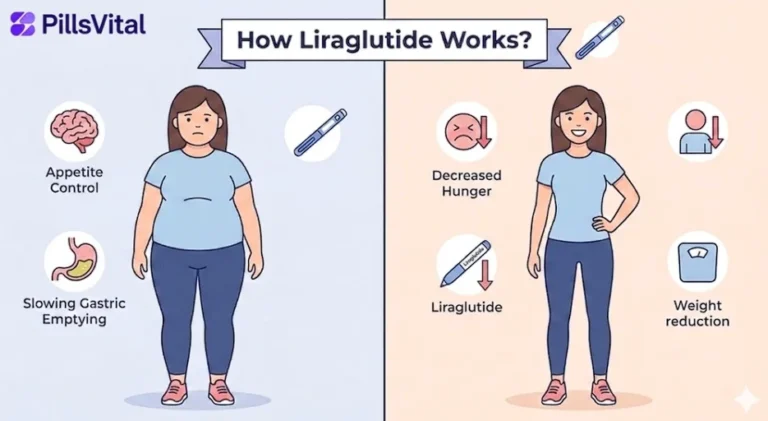
Introduction: Why Liraglutide Still Matters
Liraglutide is a GLP-1 receptor agonist used in different prescription medicines for different medical purposes. It can help reduce appetite and food intake by acting on pathways involved in hunger and fullness.
For weight management in the United States, Saxenda (liraglutide) is FDA-approved, together with a reduced-calorie diet and increased physical activity, for eligible adults and certain adolescents with obesity or adults with overweight plus a weight-related health condition. Victoza also contains liraglutide, but its FDA-approved indications are for type 2 diabetes and reduction of certain cardiovascular risks in adults with type 2 diabetes and established cardiovascular disease—not specifically for chronic weight management.
This distinction is important because Victoza and Saxenda contain the same active ingredient but are approved for different uses.
Quick answer: Liraglutide can support weight loss in eligible patients when used as prescribed alongside a reduced-calorie diet and increased physical activity. Individual results vary, and treatment should be guided by a healthcare professional.
What Is Liraglutide?
Liraglutide is a medication in the glucagon-like peptide-1 (GLP-1) receptor agonist class. For official information about approved uses, warnings, and prescribing information, see the FDA prescribing information for Saxenda.
It mimics the action of GLP-1, a hormone involved in appetite regulation, digestion, and blood-glucose control. By activating GLP-1 receptors, liraglutide can increase feelings of fullness and reduce appetite, which may help decrease food intake.
Liraglutide is available in different prescription products, and the approved use depends on the specific product.
Liraglutide products and their U.S. uses
| Product | Active ingredient | Main FDA-approved use |
|---|---|---|
| Saxenda | Liraglutide | Chronic weight management in eligible patients |
| Victoza | Liraglutide | Type 2 diabetes and certain cardiovascular-risk reduction in adults with type 2 diabetes |
Saxenda should not be combined with other liraglutide-containing products or another GLP-1 receptor agonist unless specifically directed by a healthcare professional.
How Does Liraglutide Work for Weight Loss?
Liraglutide activates GLP-1 receptors involved in appetite and metabolic regulation.
1. It can reduce appetite
Liraglutide acts on brain pathways involved in appetite regulation. This can help some people feel less hungry between meals. Because liraglutide can affect appetite and food intake, understanding medical weight loss can help put its role in context.
2. It can increase feelings of fullness
The medication can increase satiety, which may make it easier to eat smaller portions and reduce overall calorie intake.
3. It affects stomach emptying
Liraglutide can delay gastric emptying, although the effect can vary and may also contribute to gastrointestinal side effects.
4. It can improve blood-glucose regulation
GLP-1 receptor activation also affects glucose regulation. This is particularly relevant to the diabetes indication of liraglutide-containing products.
Important point
Liraglutide is not a “fat-burning” medication. Weight loss occurs primarily because the medication can reduce appetite and food intake, while treatment is used alongside diet and physical activity.
Backed by clinical findings available on PubMed clinical research on GLP-1 weight loss drugs
Victoza for Weight Loss: What You Need to Know
Victoza contains liraglutide, but Victoza is not the FDA-approved liraglutide product for chronic weight management.
In the United States, Victoza is indicated as an adjunct to diet and exercise to improve blood-glucose control in adults and children aged 10 years and older with type 2 diabetes. It is also indicated to reduce the risk of major adverse cardiovascular events in adults with type 2 diabetes and established cardiovascular disease.
Saxenda contains the same active ingredient, liraglutide, but is FDA-approved for chronic weight management in eligible patients.
Therefore, people should not assume that Victoza and Saxenda are interchangeable simply because both contain liraglutide.
If weight management is the treatment goal, discuss the appropriate FDA-approved option with a healthcare professional rather than changing or using a diabetes medication specifically for weight loss without medical guidance.
Does Liraglutide Really Work for Weight Loss?
Yes, liraglutide can help eligible patients lose weight, but the amount of weight loss varies from person to person.
Saxenda is approved for chronic weight management as an addition to a reduced-calorie diet and increased physical activity. Clinical studies evaluated weight changes over extended treatment periods rather than promising a specific result within a few weeks.
Your response can depend on factors such as:
- Starting weight
- Diet and physical activity
- Treatment adherence
- Dose tolerated
- Other medications
- Underlying health conditions
- Individual response to treatment
Don’t expect identical results
One person may lose more weight than another while using the same medication. A healthcare professional can evaluate whether treatment is producing meaningful progress and whether it should be continued.
How Much Weight Can You Lose With Liraglutide?
There is no single amount of weight that everyone should expect to lose with liraglutide.
Instead of promising a fixed timeline such as “visible transformation in 3–6 months,” weight should be monitored over time according to the prescribing information and the patient’s treatment plan.
For adults using Saxenda, the FDA prescribing information recommends evaluating the change in body weight 16 weeks after starting treatment. If an adult has not lost at least 4% of baseline body weight, the prescribing information recommends discontinuing Saxenda because clinically meaningful weight loss is unlikely to be achieved and maintained with continued treatment.
This does not mean that every person will lose exactly 4% or that weight loss occurs at the same rate for everyone.
How Long Does Liraglutide Take to Work?
Liraglutide does not produce the same result for everyone, and early appetite changes should not be interpreted as a guaranteed amount of weight loss.
Treatment is generally started at a lower dose and increased gradually to help improve tolerability.
For Saxenda, the FDA-approved adult dosage is gradually increased over several weeks:
| Treatment week | Daily dose |
|---|---|
| Week 1 | 0.6 mg |
| Week 2 | 1.2 mg |
| Week 3 | 1.8 mg |
| Week 4 | 2.4 mg |
| Week 5 onward | 3 mg |
For adults, 3 mg once daily is the recommended maintenance dose for Saxenda, while the lower doses are used for dose escalation.
Do not change the dose yourself. Dose escalation should follow the prescribing information and the instructions of the healthcare professional managing treatment.
Liraglutide Dosage for Weight Loss
The dosage depends on the specific liraglutide product and its approved indication.
For Saxenda in adults, treatment is started at 0.6 mg once daily and gradually increased to the recommended maintenance dose of 3 mg once daily.
This should not be confused with Victoza dosing.
Victoza has a different FDA-approved indication and dosing schedule. For adults, the current prescribing information starts Victoza at 0.6 mg once daily for one week, followed by 1.2 mg once daily, with an increase to 1.8 mg once daily if additional glycemic control is needed.
Do not use a Victoza dosing schedule as a weight-loss dosing schedule for Saxenda, and do not combine liraglutide-containing products.
Who May Be Eligible for Liraglutide for Weight Management?
Saxenda is FDA-approved for chronic weight management together with a reduced-calorie diet and increased physical activity.
For adults, the indication includes:
- Adults with obesity, or
- Adults with overweight and at least one weight-related comorbid condition
Saxenda is also approved for certain pediatric patients aged 12 years and older with obesity who meet the labeling criteria.
Eligibility should be determined by a healthcare professional based on your medical history, weight-related health risks, medications, and other factors.
Who Should Not Use Liraglutide?
Liraglutide is not appropriate for everyone.
Saxenda is contraindicated in people with:
- A personal or family history of medullary thyroid carcinoma (MTC)
- Multiple Endocrine Neoplasia syndrome type 2 (MEN 2)
- A serious hypersensitivity reaction to liraglutide or one of the product’s ingredients
Tell your healthcare professional about your medical conditions and all medications you take before starting treatment.
Liraglutide Side Effects
The most common adverse reactions reported with liraglutide-containing products include gastrointestinal symptoms.
These may include:
- Nausea
- Diarrhea
- Vomiting
- Constipation
- Decreased appetite
- Indigestion or dyspepsia
Gastrointestinal effects can be particularly noticeable during dose escalation. Like other prescription medicines, liraglutide can cause side effects, so it is useful to understand GLP-1 side effects before treatment.
Serious safety considerations
The FDA prescribing information includes important warnings and precautions concerning issues such as:
- Risk of thyroid C-cell tumors
- Pancreatitis
- Gallbladder disease
- Severe gastrointestinal adverse reactions
- Kidney-related adverse reactions associated with volume depletion
- Serious hypersensitivity reactions
- Pulmonary aspiration during general anesthesia or deep sedation
Seek medical advice promptly if you experience severe or persistent symptoms or symptoms that could indicate a serious adverse reaction. Before starting liraglutide, patients should discuss their medical history and other medicines with a healthcare professional. Additional patient information is available from MedlinePlus information about liraglutide.
Liraglutide vs Semaglutide (Real Difference)
Liraglutide and semaglutide are both GLP-1 receptor agonists, but they are different medications with different dosing schedules, indications, and prescribing information.
| Feature | Liraglutide | Semaglutide |
|---|---|---|
| Drug class | GLP-1 receptor agonist | GLP-1 receptor agonist |
| Common weight-management product | Saxenda | Wegovy |
| Administration | Once daily injection | Once weekly injection for Wegovy |
| Active ingredient | Liraglutide | Semaglutide |
| Weight-loss response | Varies by individual | Varies by individual |
| Dose escalation | Gradual | Gradual |
Rather than choosing a medication based only on which one appears “stronger,” treatment decisions should consider the approved indication, medical history, potential adverse effects, dosing preferences, other medications, and the advice of a healthcare professional.
Read Our detailed guide : Semaglutide vs Liraglutide
Injection vs Oral GLP-1 Medicines
Liraglutide used for weight management is administered by subcutaneous injection.
It should not be compared directly with oral semaglutide products simply on the basis of convenience because the products have different formulations, indications, dosing instructions, and absorption characteristics.
For example, Rybelsus is an oral semaglutide product with specific administration instructions. It is not the same medication as liraglutide.
The appropriate treatment depends on the patient’s medical needs and the product’s approved indication.
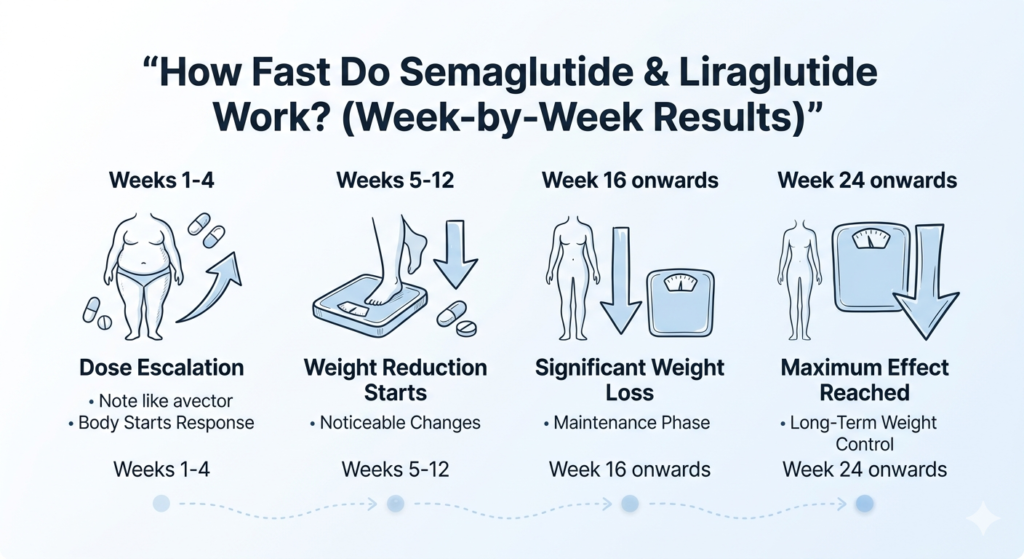
Expected Results (Realistic Timeline)
What to expect:
- Week 1–2: Appetite reduction
- Month 1–2: Gradual fat loss
- Month 3–6: Visible transformation
Important Insight:
Liraglutide is not a “rapid fat loss” drug—it’s a consistency-based system.
👉 See the full timeline breakdown: How Fast Do You Lose Weight with Semaglutide or Liraglutide?
What Happens After Stopping Liraglutide?
Liraglutide is intended to be used as part of a broader long-term weight-management strategy.
Stopping treatment may affect appetite and weight management, and some people may regain weight after discontinuing anti-obesity medication.
For this reason, patients should discuss discontinuation with their healthcare professional rather than stopping treatment or changing the dose independently.
A long-term plan may include:
- Nutrition changes
- Physical activity
- Behavioral strategies
- Regular weight monitoring
- Management of weight-related health conditions
Conclusion
Liraglutide can be an effective part of a medically supervised weight-management plan for eligible patients. However, Victoza and Saxenda should not be treated as interchangeable weight-loss products simply because both contain liraglutide. Liraglutide should be used according to a healthcare professional’s instructions; learn more about how GLP-1 medicines work in our related guide.
For people considering liraglutide for weight management, the most important factors are the correct FDA-approved product, appropriate patient eligibility, gradual dose escalation, monitoring for adverse effects, and a long-term approach that includes nutrition and physical activity.
Talk with a healthcare professional before starting, stopping, or changing any prescription weight-management medication.
Related Products
-

Slim Trim Active 60mg Capsules
$32.00 – $90.00Price range: $32.00 through $90.00 Select options This product has multiple variants. The options may be chosen on the product page -
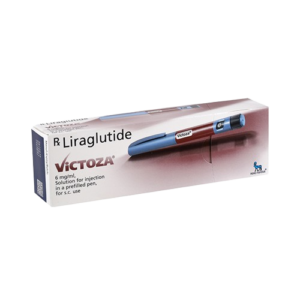
Victoza Solution for Injection
$235.00 Select options This product has multiple variants. The options may be chosen on the product page -
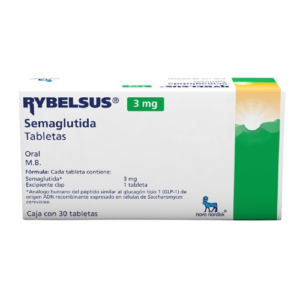
Semaglutide 3mg (Rybelsus) Tablets
$275.00 – $800.00Price range: $275.00 through $800.00 Select options This product has multiple variants. The options may be chosen on the product page -
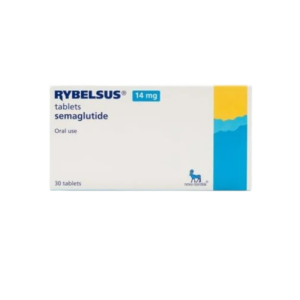
Semaglutide 14mg (Rybelsus) Tablets
$285.00 – $810.00Price range: $285.00 through $810.00 Select options This product has multiple variants. The options may be chosen on the product page
❓ FAQs
Is Victoza the same as liraglutide?
Victoza is a brand-name prescription product that contains liraglutide. Liraglutide is the active ingredient. However, different liraglutide-containing products can have different FDA-approved indications.
Is Victoza FDA-approved for weight loss?
Victoza’s current U.S. FDA-approved indications are for type 2 diabetes and reducing certain cardiovascular risks in adults with type 2 diabetes and established cardiovascular disease. It is not the FDA-approved liraglutide product specifically indicated for chronic weight management.
Is liraglutide FDA-approved for weight loss?
Yes. Saxenda (liraglutide) is FDA-approved for chronic weight management in eligible patients when used with a reduced-calorie diet and increased physical activity.
How does liraglutide help with weight loss?
Liraglutide activates GLP-1 receptors and can reduce appetite and increase feelings of fullness, which can help decrease food intake.
How often is liraglutide taken for weight management?
Saxenda is administered once daily, with the dose increased gradually according to the prescribing information.
Can I take Victoza and Saxenda together?
No. Both contain liraglutide, and the FDA prescribing information does not recommend coadministration of Saxenda with other liraglutide-containing products.
What are the most common side effects?
Common adverse reactions include nausea, diarrhea, vomiting, decreased appetite, indigestion, and constipation.
How long does liraglutide take to work?
Individual responses vary. For adults using Saxenda, the FDA prescribing information recommends evaluating weight change after 16 weeks and discontinuing treatment if at least 4% of baseline body weight has not been lost.
💊 Related Weight Loss Guides


Dr. Emily Carter specializes in evidence-based health education and wellness content. She focuses on simplifying complex medical topics related to cancer awareness, nutrition, preventive healthcare, skincare, and lifestyle wellness for readers worldwide.
This content is reviewed for medical accuracy, clarity, and alignment with current public health research. The article is intended for educational and informational purposes only and should not replace professional medical advice, diagnosis, or treatment.
One Response